PDFTechnical guide
Date not verifiedLTFS Tape Format Overview
Overview of the Linear Tape File System (LTFS) for open, portable tape archives.
- Vendor:
- QStar
- Date:
- 2022
- Format:
- Size:
- 1.2 MB
Petabytes, powered down
Tape remains the lowest cost per terabyte for very large offline archives. Planning one properly means planning the drive refresh, not just the capacity.
Aban Smart integrates QStar archive software with LTO libraries from the manufacturers our clients already run, and states plainly what we have verified and what we have not.
Cost per terabyte is why tape is still here, and at petabyte scale nothing else comes close. But the durable risk in a tape archive is rarely the cartridge. LTO media is specified for decades in reasonable storage conditions, and most cartridges outlast the interest of the people who wrote them. The risk is the drive. In fifteen years, will anything on site still read the format you are writing today? That single question drives refresh planning, format choice, and how much attention vendor independence deserves.
Export to shelf is what turns a library into an air gap.
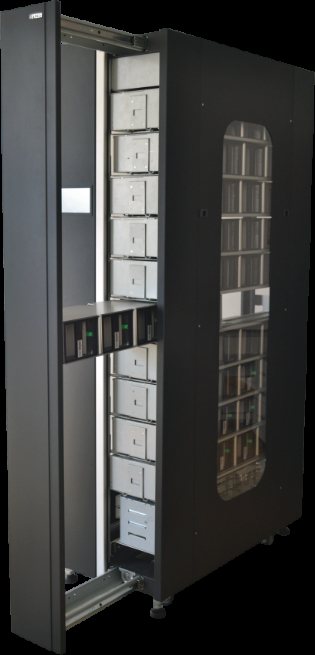
Strip a library down and there are four moving concerns.
Slots hold the cartridges and set raw capacity. Adding slots is usually the cheapest way to grow, since capacity scales with media rather than with electronics.
The picker is the robot that moves cartridges between slots and drives. It is a single point of mechanical wear, and libraries above a certain size offer a second one. Whether you need redundancy there depends on how much of your recall traffic is time-bound.
Drives set throughput and, more importantly, set the format. Drive count is the variable people most often under-buy, because it looks like a line item rather than a performance parameter.
The mail slot is the import and export port. It is where cartridges leave for the shelf and where imported media comes back in. Operationally it is the most interesting part of the machine, because it is the boundary between an online tier and an offline one.
Capacity is bought in slots. Speed is bought in drives. Confusing the two produces a library that is large and slow, which is the most common configuration mistake we see.
Tape is a streaming device. It performs well when data arrives continuously at or above the drive's native rate, and badly when it does not.
When the incoming stream falls below that rate, the drive runs out of buffer, stops, reverses, repositions and restarts. This is shoe-shining, and it is worse than a simple slowdown. Effective throughput can drop by a large multiple, and the repeated repositioning wears both head and media. A library that appears to be underperforming is often a library being starved by its source.
The usual fix is a staging cache in front of the drives, sized so that writes land on disk at network speed and drain to tape at tape speed. QStar's published guidance describes a small fast write cache, on the order of a few terabytes of NVMe, paired with slower and larger disk for read caching. That asymmetry is deliberate: writes need burst absorption, reads need breadth.
Parallelism is the other lever. QStar cites six LTO-6 drives writing in parallel at around 960 MB/s and six LTO-8 drives at around 2.1 GB/s. Those are manufacturer figures for aggregate streaming under favourable conditions, not a guarantee for your workload. Once an initial bulk ingest has drained, drives can be reassigned from writing to reading or held as spares, since steady-state ingest is usually far below the migration peak.
LTFS is what separates a modern tape archive from a proprietary backup format. It is an open, self-describing layout: each cartridge carries an index partition alongside the data, so the tape explains its own contents without reference to an external database. The specification is genuinely public rather than vendor-controlled. It originated at IBM, is now developed through the SNIA technical working group, and is published internationally as ISO/IEC 20919.
The practical consequence is exit. A cartridge written in LTFS can be carried to a standalone drive at another organisation, mounted, and read without the software that wrote it. If your archive software vendor disappears, is acquired, or simply becomes unaffordable, the media remains readable. Few storage decisions offer that.
Plain LTFS has a well-known nuisance: each cartridge presents as its own volume, so a library of two hundred tapes presents two hundred mount points. QStar Archive Manager addresses this with LTFS volume spanning, presenting all media in the library as one or more continuously growing network shares over SMB, NFS or S3, and adding new cartridges to the set automatically as existing ones fill. File metadata is held both on disk and on the LTFS media, and media that has been exported is still tracked. More on that layer sits on the archive management software page.
Worth being precise about what portability does and does not cover. The LTFS format is open and readable elsewhere. The spanning index, retention policy state and cache behaviour belong to the archive software. You retain the ability to read your data without the vendor. You do not retain the vendor's features.
This is the constraint that should shape a fifteen-year plan, and it is routinely discovered late.
LTO drives read and write a limited window of older generations. For generations up to LTO-7 the pattern was two generations back for reading and one back for writing. From LTO-8 onwards that window narrowed to one generation back for both. Confirm the exact behaviour for the specific generation you are buying, because the rule changed mid-roadmap and the older description is still widely repeated.
What follows from it:
| Planning question | The implication |
|---|---|
| How old is the oldest media in the archive? | If it predates the current drives by more than the window, you cannot read it without keeping legacy drives running |
| What happens when a legacy drive fails? | Spares for retired generations become scarce and expensive, and eventually unavailable |
| When should media be migrated forward? | While drives that read the old format and write the new one still coexist, not after |
| Who tracks this? | Someone must own it, or nobody does |
Format migration is therefore a scheduled activity, not an emergency response. Copying a large archive forward a generation takes drive time, cache and calendar, and it competes with production ingest. Building it into the refresh cycle costs far less than a recovery project against dead hardware. The long-term archiving approach covers how that sits alongside retention policy.
A cartridge in the mail slot becomes, once removed, a copy no network can reach. That is the cleanest air gap available at scale, and it costs almost nothing beyond process.
Two honest qualifications. First, cartridges inside a networked library are online storage, whatever the marketing says. The gap exists only after removal. Second, standard LTO media is append-oriented rather than write-once, and can be reformatted or bulk-erased by anyone with physical access and a drive. It resists the overwrite patterns ransomware uses, which is a meaningful reduction in risk, but that is not the same property as media that cannot be rewritten.
LTO WORM cartridges are the middle option here and are worth naming precisely. They have been part of the roadmap since LTO-3 and are supplied for current generations. Enforcement comes from the drive firmware reading a WORM flag in the cartridge memory chip and then declining to overwrite already-written areas. That is a firmware rule about a specially manufactured cartridge, so it is stronger than a policy on rewritable media and weaker than a recording layer that has been physically changed. Where that last distinction decides the argument, optical archive systems is the relevant comparison.
QStar also offers a Mount-on-Date function that presents the archive as it stood at a chosen earlier point, which helps when encrypted content has been appended after an intrusion. Like any recovery mechanism it depends on detecting the intrusion within the retained window.
Tape earns its place on volume and on power. A cartridge sitting in a slot consumes nothing, which matters both for GCC cooling loads and for anyone reporting on infrastructure energy. Research computing and media archives are the natural fit: large sequential files, predictable growth, retention measured in decades. The research, AI and HPC and media and video surveillance pages go further into those workloads.
It is a poor fit for small random recalls. Every miss against the disk cache costs a robotic move, a load and a seek, so first-byte latency runs from tens of seconds into minutes. Anything latency-sensitive, transactional, or read in many small scattered pieces belongs on disk or object storage.
QStar publishes joint solution briefs with tape library manufacturers including Spectra Logic, and those documents are the manufacturers' own material rather than evidence of any Aban Smart partnership or certification. We reference them for technical detail only.
Replacement is not always the answer. An existing library that has fallen out of use as backup infrastructure can often be brought back as an archive tier by adding a modest Linux or Windows server and archive software in front of it.
The pattern QStar describes puts an S3 endpoint on that server, so cloud-aware applications write to the library as though it were an object store, on premises, with no egress charges. The white paper illustrates the point with a two cent per gigabyte egress rate producing roughly twenty thousand dollars to retrieve a petabyte. That is the manufacturer's illustration rather than a quote for any provider, but the direction is right: large restores from public cloud carry a bill that rarely appears in the original business case.
Older generations still work for this. QStar notes that even LTO-3 and LTO-4 libraries can serve as an on-premises object target, slower but functional. That makes repurposing a genuinely low-risk experiment before committing to new hardware.
Other technologies are listed on the technologies overview. For a library configuration sized against your ingest rate, recall profile and refresh horizon, request configuration and pricing.
Manufacturer documentation relevant to this page. Availability, specifications, and configurations are subject to verification.
Overview of the Linear Tape File System (LTFS) for open, portable tape archives.
Technical guide to using existing tape libraries as a tape-as-cloud active archive.
Active Archive using QStar software with Spectra Logic tape libraries. Confirm supported configurations.
Manufacturer specifications for archival life run to several decades under controlled temperature and humidity, and media is usually not the component that fails first. Drive generation compatibility is the shorter clock. Plan on migrating data forward every few generations while drives capable of reading the old format and writing the new one are both still available and supportable.
Share the workload, capacity, retention, access, and resilience requirements. Aban Smart will identify the next discovery inputs and the appropriate engagement path.